
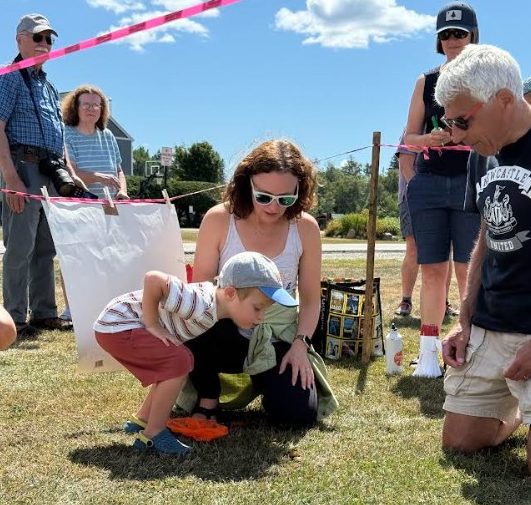
As the current organizer of the annual Frog Jumping Contest held at the Rangeley Blueberry Festival, I’ve had the pleasure of holding this event for 25 years, most recently on August 21. How it occurred that I’m the one marking this anniversary goes back to when my three sons entered this contest as kids. Judy Hunger, former Publisher and Editor of Highlander, ran it back then. After they participated under Judy’s organizational skills for a couple of years, Joanne Raymond took over as the one in charge.
Then one summer my boys showed up, frog in hand, only to learn that there was no contest. I realized then that if I wanted them to continue to experience this unique event, I’d have to run it myself. And so, beginning in 2000 I began managing it and continued with the help of an army of volunteers (army is also the term for a group of frogs). These included the Boy Scouts and my own son Felix, who, after losing interest in competing, took over as judge. This year I was thankful for the enthusiastic help of my husband Michael Holoszyc, Juno Knox, Kari Silloway, Emil Nieser, and Fred Dubay as photographer.
I wanted every child to get a prize, so I modeled this competition on Nancy Kettle’s Around the Island Races. Besides First, Second, and Third Prizes, Nancy would give out arbitrary prizes in a variety of categories. I’d likewise give prizes for such characteristics as “Greenest Frog” or “Most Meditative.” The generosity of the business community allowed each child to take home an award.
I’m not sure how long Judy had been running that contest before my children arrived on the scene. And I’m certainly not sure how long the competition was held before that. Someone might know, and if so, please inform me. Now that I see former winners bring their own children to compete, this I do know for sure: The Frog Jumping Contest is definitely established as a Rangeley tradition, and one that I hope continues.
Comments are not available on this story. Read more about why we allow commenting on some stories and not on others.
We believe it's important to offer commenting on certain stories as a benefit to our readers. At its best, our comments sections can be a productive platform for readers to engage with our journalism, offer thoughts on coverage and issues, and drive conversation in a respectful, solutions-based way. It's a form of open discourse that can be useful to our community, public officials, journalists and others.
We do not enable comments on everything — exceptions include most crime stories, and coverage involving personal tragedy or sensitive issues that invite personal attacks instead of thoughtful discussion.
You can read more here about our commenting policy and terms of use. More information is also found on our FAQs.
Show less