
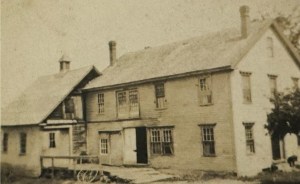
The Otisfield Historical Society’s final program for 2025 will begin at 7 p.m. on Thursday, September 11, at the Otisfield Town House on Bell Hill Road. Our speaker will be archaeologist Dr. Barry Rodrigue. He will be talking about his work as a professional archaeologist and how his work helps historians understand missing parts of traditional history. Included in his presentation will be the results of his archeological survey of an Otisfield 19th-century site known as Hancockville Village. Shown here is a photo of Nathan Nutting Jr’s building, located in the Village as seen on the 1857 map. It was used for the manufacture and repair of carriages. The building on the left was used for blacksmithing. It was said not to have been much of a commercial success and was torn down before 1950.
OTISFIELD — The Otisfield Historical Society’s final program for 2025 will begin at 7 p.m. on Thursday, September 11, at the Otisfield Town House on Bell Hill Road. Join us as we welcome Dr. Barry Rodrique, a historical archeologist, to Otisfield. His program will include information on how archaeology helps historians understand missing parts of traditional history.
He’ll also talk about his findings from an archeological survey completed in the fall of 2024 at a new development at Gould’s Corner, originally known as the village of Hancockville. This parcel was flagged for evaluation because of wetlands, surface artefacts, a visible foundation, and a farm and a commercial site shown on 19th-century maps.
Dr. Rodrique is a professor of anthropology at the School for Liberal Arts, Symbiosis International University, Pune, Maharashtra, India. As a Fulbright Scholar, he worked as a research geographer at Laval University, from where he co-authored a regional history for the Quebec National Institute of Scientific Research.
Additionally, he is an associate professor of humanities at the University of Southern Maine and a state-certified archaeologist who contracts for cultural resource management surveys.
Refreshments will be available after the Program.
Comments are not available on this story. Read more about why we allow commenting on some stories and not on others.
We believe it's important to offer commenting on certain stories as a benefit to our readers. At its best, our comments sections can be a productive platform for readers to engage with our journalism, offer thoughts on coverage and issues, and drive conversation in a respectful, solutions-based way. It's a form of open discourse that can be useful to our community, public officials, journalists and others.
We do not enable comments on everything — exceptions include most crime stories, and coverage involving personal tragedy or sensitive issues that invite personal attacks instead of thoughtful discussion.
You can read more here about our commenting policy and terms of use. More information is also found on our FAQs.
Show less