
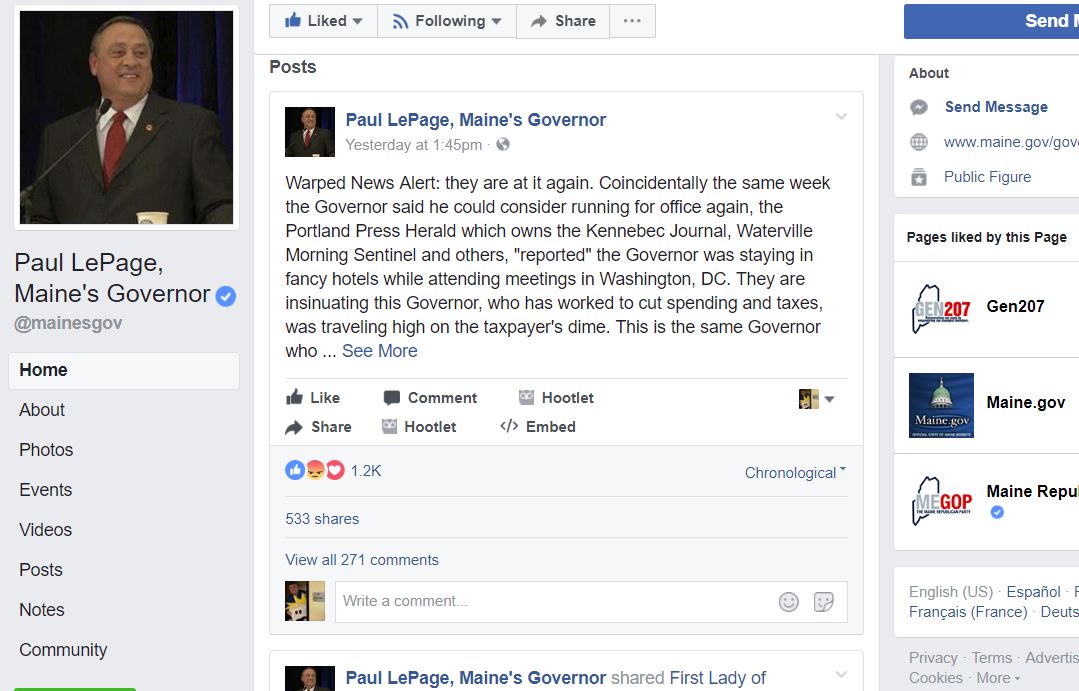
AUGUSTA — The American Civil Liberties Union demanded Monday that Gov. Paul LePage stop censoring his official Facebook page to delete comments he doesn’t like and block opponents from accessing or commenting on it.
“The governor doesn’t get to decide who speaks and who doesn’t, based on whether they are praising him or disagreeing with him,” Zachary Heiden, legal director at the ACLU of Maine, said in a prepared statement.
“The First Amendment protects the right of all people to express their opinions to the government. Social media may be a relatively new forum for public speech, but the Constitution still applies,” Heiden said.
The governor’s office was asked for a response but hasn’t yet provided one.
In a Monday letter to LePage, the ACLU gave the governor 14 days to respond favorably or “it will be forced to take additional action to protect the rights of the people of Maine to communicate with their government.”
The nonprofit legal group said courts have repeatedly ruled that citizens have a right to use Facebook and other social media to exercise their First Amendment protections to speak out on issues.
The ACLU noted that LePage has hailed Facebook as a way to reach citizens directly without relying on the traditional media. He has also pushed for state agencies to use the social media network.
When Mainers respond, Heiden said in his letter, “they have engaged in core political speech that is fully protected by the Constitution,” whether or not their words support or oppose the governor.
The ACLU cited three examples of Mainers whose comments were deleted from LePage’s page and who were themselves blocked from accessing it.
Comments are not available on this story. Read more about why we allow commenting on some stories and not on others.
We believe it's important to offer commenting on certain stories as a benefit to our readers. At its best, our comments sections can be a productive platform for readers to engage with our journalism, offer thoughts on coverage and issues, and drive conversation in a respectful, solutions-based way. It's a form of open discourse that can be useful to our community, public officials, journalists and others.
We do not enable comments on everything — exceptions include most crime stories, and coverage involving personal tragedy or sensitive issues that invite personal attacks instead of thoughtful discussion.
You can read more here about our commenting policy and terms of use. More information is also found on our FAQs.
Show less