
AUBURN — When Joan Benoit Samuelson teamed up with Nike for an ad campaign two decades ago, the finished product was titled “There is no finish line.”
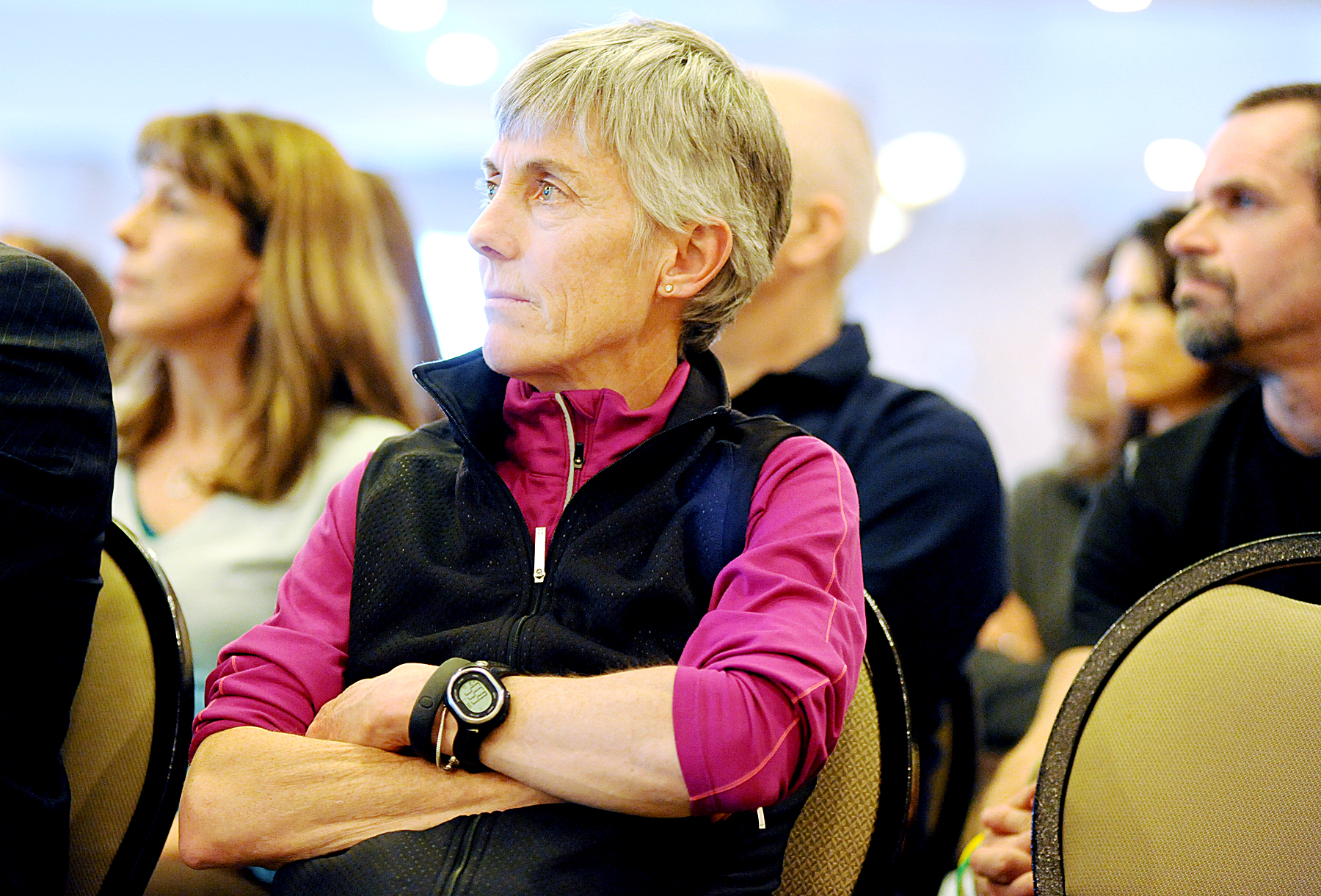
It was just a mere slogan to her at the time, but it is now the theme of which she preaches. She was in Auburn Tuesday to speak to a sizable crowd as part of the Great Falls Fitness Seminar Series.
The first program was called “Hit The Ground Running,” an evening with Olympians, featuring Samuelson and fellow former Olympic runner Dr. Jay Kearney.
Samuelson said it was one of the largest running crowds she’s spoken to in Maine, and she stressed her theme of sticking to goals and never being satisfied.
“I didn’t understand the adage (There is no finish line) at the time,” she said. “Come to find out, I’m living that. With every finish line I cross, there’s a new reason to keep going.”
Samuelson’s running career was highlighted with a brief video produced for the “There is no finish line” campaign. After being an All-American at Bowdoin and winning two Boston Marathons, she won the first-ever women’s Olympic marathon gold medal in Los Angeles in 1984.
Having done all that by age 27, she had a lifetime of goals and finish lines to cross after those achievements.
“After winning the gold medal, my mother thought, ‘Well, now you can quit.'” she recalled. “I still had goals. I never thought about retiring or quiting because I still had goals I had put out there for myself.”
She’s continued to be a significant force in the running world. She won the Chicago Marathon with an American record time of 2:21:21 in 1985. She’s been a consultant for Nike, written books, conducted fitness clinics and done motivational speaking.
In 1998, she founded the Beach to Beacon 10K, which has become the largest running attraction in the state and a premier race for some of the world’s elite. It boasts over 6,000 runners each August.
“To me, the biggest benefit of that race is being able to draw people from the sidelines who become inspired,” she said, noting that the race also benefits a children’s charity each year. “They say, ‘Maybe I can do that.'”
Samuelson didn’t want to just inspire the crowd Tuesday night. She wanted to encourage their passion and use her life stories to motivate them. She spoke of her 2008 running of the Olympic Marathon Trials in Boston and vowing it would be her last competitive race, running a sub 2:50 at age 50. She subsequently continued running marathons when places like New York and Chicago made running irresistible. She was recently in Japan and had no intention of running a race there but was inspired to run despite nursing an injury.
“I’m not normal,” she joked. “I have a gift. I have a passion and that allows me to keep going.”
She told her fellow runners that they can do the same in the context of their running. She stressed the need to blend that passion with balance and mix in a little persistence, patience and perseverance.
“You have to believe in what you want to go with for your goals and don’t compromise,” she said.
She admits she still loves the sport, and one of the reasons why is because it still challenges her and still has her striving for the next finish line.
“It’s a pure sport,” she said. “You can’t hide anything in our sport, and I can’t hide the fact that I still love to run.”
Her advice was for her fellow runners to continue striving for their own finish lines.
“It’s basically about running your own race,” she said. “You can’t run somebody’s else’s race in life but your own. That’s apropos to what anybody does in their own life, whether it’s in the arts, the work place, music or whatever. You have to run your own race and you’ve got to believe in what you’re doing to develop that passion.”
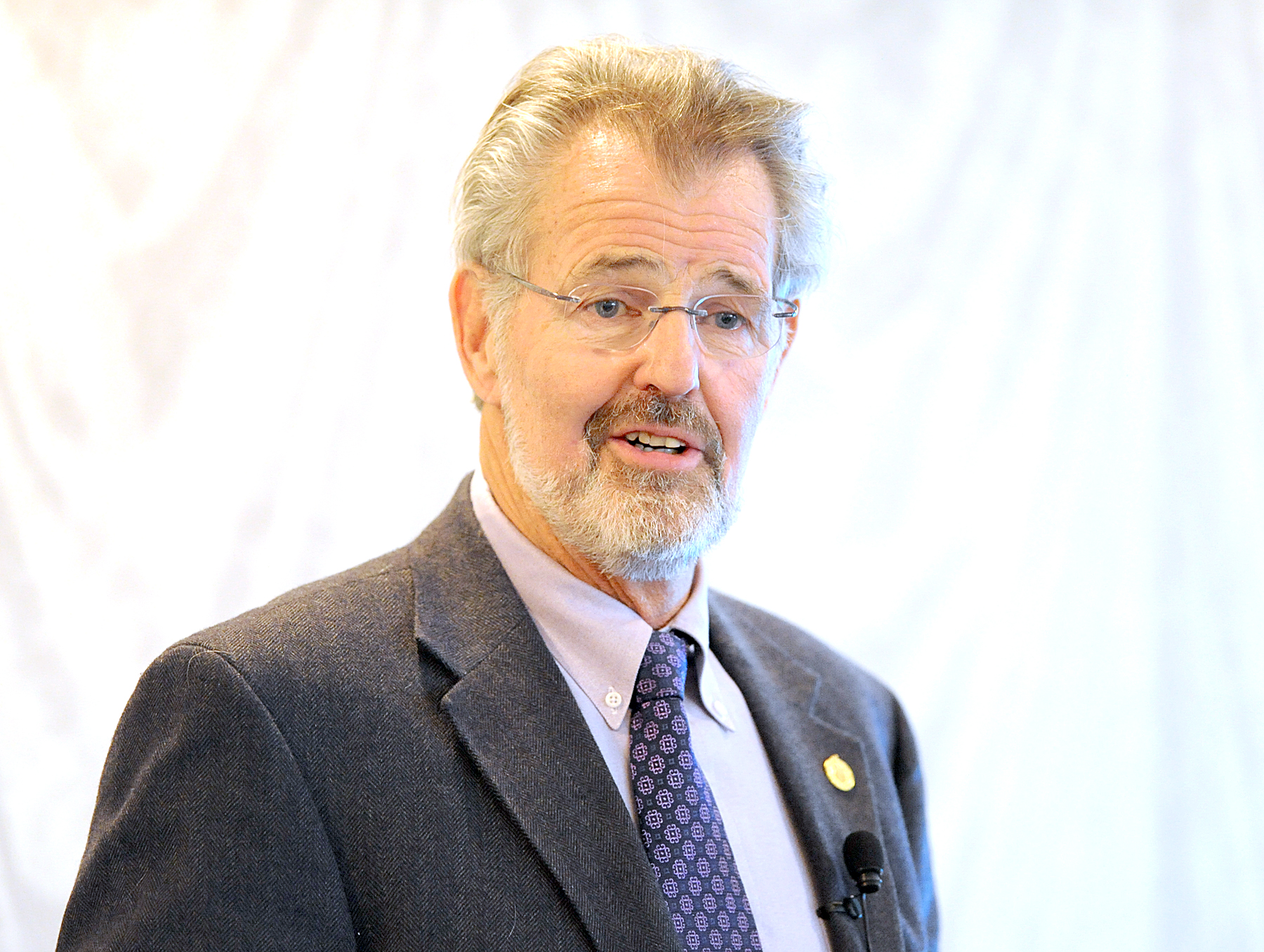
Kearney is a former Olympian and has spent over 30 years working with athletes at all levels. He’s worked with the United State Olympic Committee and served as the Senior Sports Physiologist for the USOC. He most recently led a team to coordinate the U.S. Olympic Teams presence at the 2008 games in Beijing.
His introductory talk focused primarily on why we run. He highlighted a study on how man is inherently a running machine and has followed an evolutionary path toward that.
He said the study showed that man has evolved to run and has been aided in that endeavor because the human body adapts well to heat loss, has elongated and elastic tendons, large lower body joint surface, head stabilization and long slender legs.
As to why runners run, he cited such things as the challenge, social aspects, solitude, racing for causes, self discipline, confidence and health.
“Exercise is like compound interest,” said Kearney, who is currently a Senior Consultant for Osprey Leadership Consulting Inc. “You pay a little each day and it all adds up.”
The program also featured a collection of speakers from Central Maine Orthopaedics, including Dr. Paul Cain, Dr. Elizabeth Rothe, Dr. Michael Saraydarian and physical therapist Eric Gosslin. They discussed such medical concerns such as knee issues, gastrointestinal problems, foot ailments and physical therapy.
The panel also hosted a question and answer session at the end of the evening.
kmills@sunjournal.com
Comments are no longer available on this story