
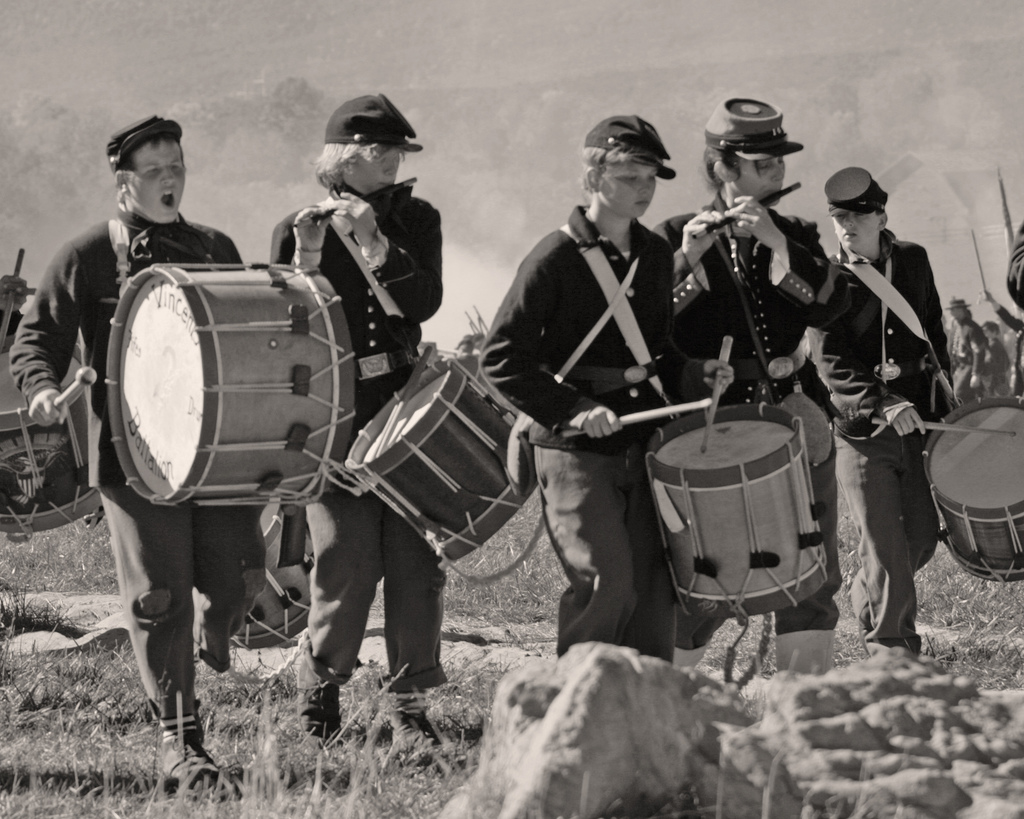
The Civil War is often called “The Boys War” as many young men ran away from home to join the military and saw action as drummer boys and musicians. This very realistic image is probably a reenactment. (Courtesy photo)
May 15, 1850 – Nov. 17, 1918
He came about as close to becoming an all-American citizen as any of us are ever likely to. From the hour of his birth, Burke’s struggles enabled and ennobled him for an eventual placement in this study. Like so many youthful musicians caught up in “This Strange Sad War” {Walt Whitman}, he fitted their mold all too well.
Soon following Andrew’s arrival amidst a difficult delivery, he lost his mother, whose identity has not been preserved – effectually a double loss. This tragedy happened in New York City. He never knew her voice, her embrace, her affection. He had to look to his father for these luxuries, a father who was working long hours to provide whatever home he could for his only child. Then when Andrew was not yet five, his father- name unavailable–also died somewhere in New York City.
Little Andrew was rescued by the newly founded New York Children’s Aid Society (1853), one of whose originators, Charles Loring Brace (1826-1890) would influence the quality of this lad’s immediate future. Orphans, like Andrew, were routinely consigned to a Juvenile Asylum at a projected annual expense of$150. Mr. Brace’s sentiments (convictions) allowed:
(We (Children’s Aid Society) … took the ground that, as our children were not criminals, but simply destitute and homeless boys and girls, usually with some ostensible occupation, they could not easily, on any legal grounds, be enclosed within Asylums; that, if they were, the expense of their maintenance would be enormous … .
Furthermore, we held that an asylum life is a bad preparation for practical life. The child most of all needs individual care and sympathy. . .. The longer he is in the Asylum, the less likely he is to do well in outside life … We hope, too, especially to be the means of draining the city of these children, by communicating with farmers, manufacturers, or families in the country, who may have need for employment. When homeless boys are found by our agents, we mean to get them homes in respectable, needy families. These are the little ones of Christ.”
Brace’s Children’s Aid Society (CAS) advocated moving these children to the West promptly, though the Juvenile Asylum system believed in a season of institutional taming and training before placement. Brace felt that supplying labor needs in the West was in harmony with the divine principle of the family system. His Society first sent its child emigres out West in 1855. By 1857, homes had been found for some 600 urban orphans by this humane effort, tickets west being the only real expense.
By age five Andrew was “taken in charge of’ by the New York CAS, who gave him food and shelter, and likely, a bit more of kindness than would have been awaiting elsewhere. At almost eight, Andrew, with a few other boys and girls was sent to Indiana. Here, outside of Noblesville, he was placed on a farm that spring of 1858 and assigned a round of daily errands and chores commensurate with his abilities. For the first time experiencing a semblance of family living, Andrew acquired sound formative habits under a disciplined system of agrarian peer pressures. While
it is probable that all was not to his liking, the work-farm atmosphere effectively developed his native
endowments: the boons of responsibility, dependability, honesty, industry, humor, and sessions of country schooling he came to appreciate. What cannot be reported today are the precise circumstances as to how our Andrew got off the farm and into the Union Army. That he used his own name rather than an alias, that he enlisted there at Noblesville within a few miles of home would appear to suggest that he had, after four full years, earned the confidence and approval of his surrogate parents, that he was not a runaway.
He did, after all, return to Noblesville upon his expiration of duty. Reporting his age as thirteen, Andrew successfully enrolled July 17, 1862, as a drummer boy for three years. On that day in Noblesville he was 12 years 2 months 2 days and described by one J. W. Evans as 4′ 10″, sandy complexion, blue eyes, light hair. Within a month,
Andrew arrived in Wabash, Indiana, where he became a member of the 75th Indiana, mustering in with them at their organizing on August 19th. Andrew was to serve in Capt. John H. Butlers Company D. During most of his tour Andrew’s regiment was attached to the 40th Brigade, 12th Division, Army of the Ohio, but for his own last five weeks of service the 75th Indiana were with the 2nd Brigade, 5th Division., 14th Army Corps, Army of the Cumberland.
While Burke’s service was brief he nonetheless got ample taste of the insanity of war. His regiment left for Louisville, Kentucky August 21st and proceeded to Lebanon. With but six weeks of drill and training, the 75th were thrown into pursuit of General Bragg’s forces all during October. At the Battle of Perryville (Chapin’s Hill) on the 8th, Drummer Boy Burke withstood assaults – (the noisiest, most dreadful day of his life ) – upon his very soul, caught in a pathetic glory of heroism that killed outright 916 of his fellow blue clads, that wounded another 2,943 (many of whom died slower), with still another 489 missing.
While they imposed some 2,500 miserable casualties upon the Southerners. Though the 75th’s casualties were light that day, just hearing about a comrade’s sudden death or maiming was a sickening novelty for this lad. In fact, after their march to Bowling Green (Oct. 26-Nov. 3) and Scottsville, Kentucky (Nov. 10th), Burke became ill for the rest of 1862, unfit for duty some thirty of those days.
He was with the 75th Indiana as they pursued John Hunt Morgan to Glasgow and on into Tennessee. By order of General Rosecrans, Andrew Burke was discharged Jan. 5, 1863, at Castalian Springs, Tennessee. Veteran Andy, having completed his military escapade, resumed his former duties (and a few new ones) and his relationship at his farm home outside Noblesville.
Already his ambition was to conquer poverty. Education, he felt, would be his path. So he disciplined himself to read and study whenever, wherever such opportunity arose during the mid and late 1860s. By 1867, he aspired to the privilege of a college education, knowing it was not his right but rather a desideratum he’d have to struggle for.
By winter-spring 1868 he was enrolled in liberal arts at Indiana Asbury University at Greencastle, founded in 1837 under auspices of the Methodist-Episcopal Church and since 1884 known as DePauw University. In the five and a half years since his Civil War service he grew a foot more. But whatever his American-dream rise was, it was beset with certain stark realities he had been addressing all along; two of these were his less than robust health and the necessity of maintaining self-support.
Now, additionally, he was attempting to be a full-time college student. After only a few semesters of intense study, Andrew found the pace to be excessive, his health broke under the strain, and he was forced to put aside the books if he was to recover from such a relapse. Andrew wisely dropped out of school. (Continued next week – Part 2)
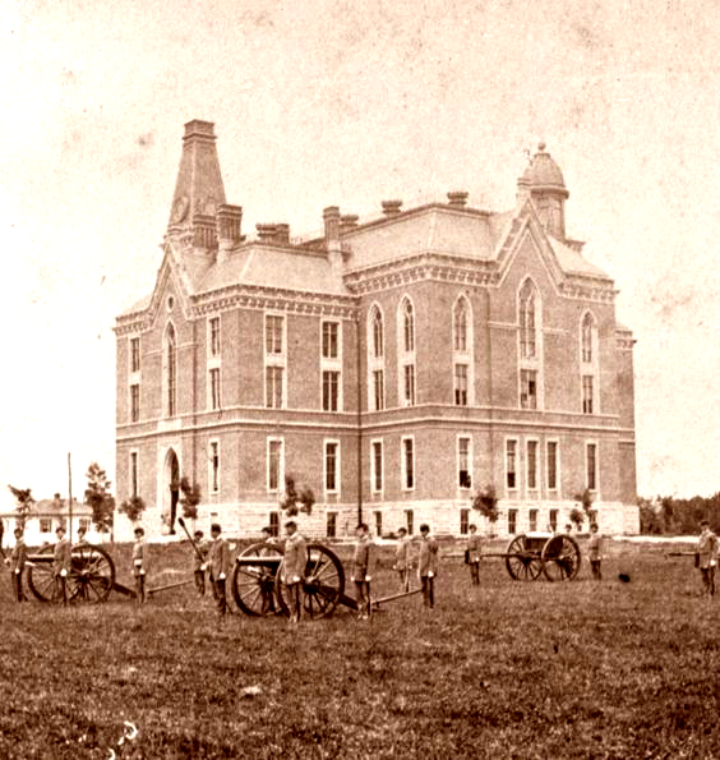
The Indiana Asbury University as it must have looked when Andrew Burke attempted to attend, but fell ill and had to drop out.
Comments are no longer available on this story