
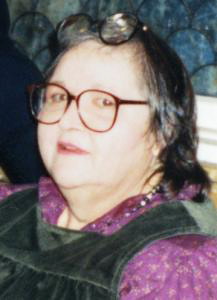
Behind the wheel of her 1972 Mercury station wagon filled with art reference books, auction reports, sales catalogues and notes on paintings and dealers, Selma Koss Holtz traveled across New England, stopping at barn and estate sales and antique shops, looking for her next undiscovered treasure.
She called the wagon, which often also carried art colleagues or her reluctant children, “my office.”
In the 1960s, several years after leaving her hometown of Auburn, Mrs. Holtz, a Bates College graduate, began her illustrious career as an art and antiques dealer, appraiser in American art, collector and curator, all self-taught.
She died Sept. 9 of cancer at her Newton home. She was 78.
“Selma was a larger-than-life character in the Boston commercial art scene,” said Karen Keane, chief executive of Skinner. “She was a savvy dealer in a wonderful under-the-radar manner. She had no office. She was extremely opinionated. She knew what she liked and was able to negotiate her way in a world not easy for a woman. She had a great eye and a sense of connoisseurship. She also had a naughty side, which was infectious.”
The Selma Koss Holtz collection included paintings by John Joseph Enneking, John Marin, N.C. Wyeth, William Bradford, Dennis Bunker, Lilla Cabot Perry and Charles Woodbury, according to her son, Herbert L. Holtz of Charlestown. It also included bronzes by Augustus Saint Gaudens, Jo Davidson and Kahlil Gibran, he said, along with etchings by Howard Pyle and Rockwell Kent.
Mrs. Holtz had a detective’s eye for paintings. Her son said she exposed as fake a painting that appeared to have been signed by the Impressionist landscape artist John Henry Twachtman, who died in 1902, because the buildings in it were not built until World War I.
The parties that Mrs. Holtz hosted at her Newton home — with its candelabras, exquisite table settings, mounds of delectable food prepared by Mrs. Holtz, and its fascinating guests — were talked about as much as her achievements in the art world.
She was born in Auburn, daughter of Joseph Koss, a Russian immigrant who started out as a fruit peddler and worked his way to ownership of shoe factories in Maine. She graduated from Lewiston’s Bates College with a major in English in 1955.
In 1956, she married Norman Holtz, a labor lawyer, and they moved to Buffalo. In 1959, they moved to Massachusetts and settled in a house in the Waban section of Newton. The marriage ended 14 years later, their son said, but they remained close friends. Mr. Holtz died in 2007.
While Mrs. Holtz worked with a number of museums, she maintained close ties to the end with the Ogunquit Museum of American Art in Maine, and her expertise and research is recognized in a number of its catalogues, among them, American Impressionists in 2000 and paintings of Enneking in 2001.
Michael Culver, former director of the Ogunquit museum, now director of Naples Museum in Florida, recalled her as “a great source of research” while he was at Ogunquit. “Selma would call you out of the blue at 8 at night or 1 in the morning and talk for hours about art,” he said. “It was always a learning experience.”
Though hospitalized in her final illness, Mrs. Holtz dispatched her daughter-in-law and nurses to buy paintings at an auction. They returned after hospital hours with her treasures.
In addition to her son, Mrs. Holtz leaves a daughter, Jane, of Charlestown; two brothers, Herbert Koss and Edward Koss, both of Lewiston, Maine; and two grandchildren.
At Ogunquit Museum, where her name is “everywhere in the collection,” Ron Crusan, its director, said there will be a memorial exhibition in her name in the spring. The Selma Koss Holtz Acquisition Fund has been initiated as a permanent memorial there.
© Copyright 2009 The New York Times Company
Comments are no longer available on this story